London Councils: Skills Match


What London Council’s needed
Youth unemployment was a major issue affecting London; at the time we were commissioned 24.7% of 16-24 year olds were unemployed compared to 20.9% nationally. London Councils’ Young People’s Education and Skills (YPES) Board identified that a more rational and informed process was required to ensure the skills of young people match the requirements of employees and the London economy. This would address skills shortages fostering a training infrastructure that accommodates the requirements of new areas of growth at a geographically specific level, and stimulate economic recovery by ensuring employers have an appropriately skilled workforce at their disposal. However, these objectives were made challenging due to the disconnect between education and curriculum policy and the needs of employers.
Additionally, there was no way of matching qualification data to data on what skills are needed by employers. Specifically, the taxonomy used for categorising school and college qualifications (sector subject areas – or SSAs) did not map to standard industry (SIC) and occupation (SOC) classifications, making linking data for policy purposes impossible.
What we did
Fortunately, at the time we were discussing these challenges, the government was focussed on releasing open data for analysts to create new data products, which gave us the opportunity to tap into a vast array of raw datasets. We collaborated with London Councils and applied to the Open Data Breakthrough Fund to build what become Skills Match.
The project had five stages:
- Discussions with a wide range of stakeholders from 25 different policy and training organisations, to work out what the intelligence gaps were, and how analysis should be presented. We used this research to identify likely user personas:
- Pan-London bodies to strategically plan provision across London based on identified employment and skills gaps
- Local authorities to have access to local labour market information, and strategically plan local skills development, regeneration and business innovation
- Training providers such as colleges to create skills and learning provision that suits the need of the London economy
- Careers advisors to identify local skills gaps by subject and provide informed advice to young people
- Employers to understand and tap into their local labour market
- Young people/parents to identify provision that supports their chosen career path and identify local vacancy trends in related industries
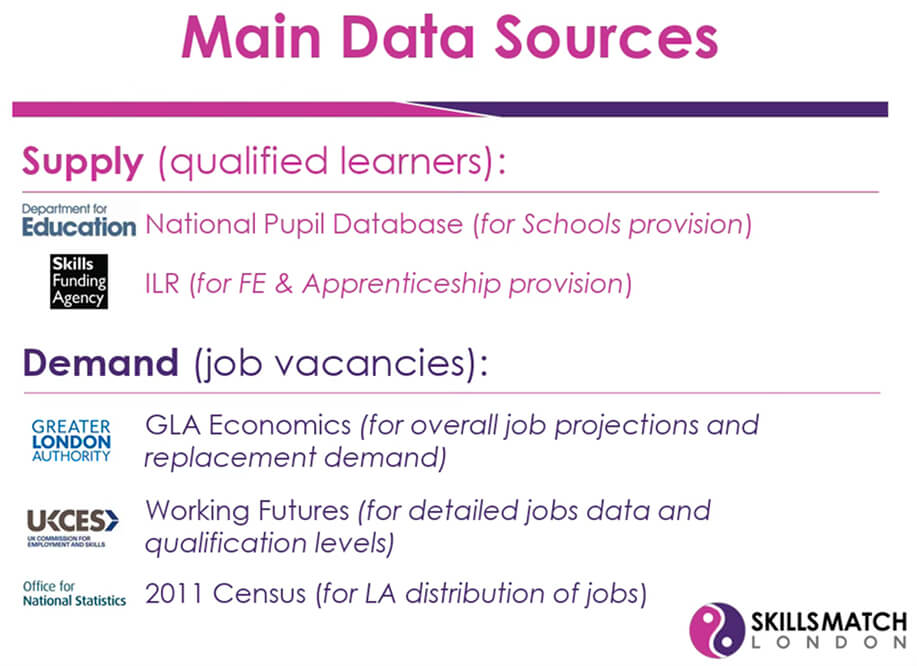
- Researching available datasets that could be used to identify skills mismatches between post-16 school and college provision, and industry labour market growth. The datasets we identified are shown here. One addition to the existing data, was creating a third tier of the Sector Subject Area classification; this was needed since the second tier had such a wide range of subjects they were very hard to tag to individual occupations, but going to a specific qualification level was unsustainable, given the tens of thousands of qualifications
3. Developing and testing an algorithm to match the volume of qualifications at different qualification levels (supply) to skills shortages tied to occupation codes (demand). Due to the different ways these two classifications were structured, we created a many to many relationship, where supply from one subject code could be apportioned to multiple occupation codes and vice versa.
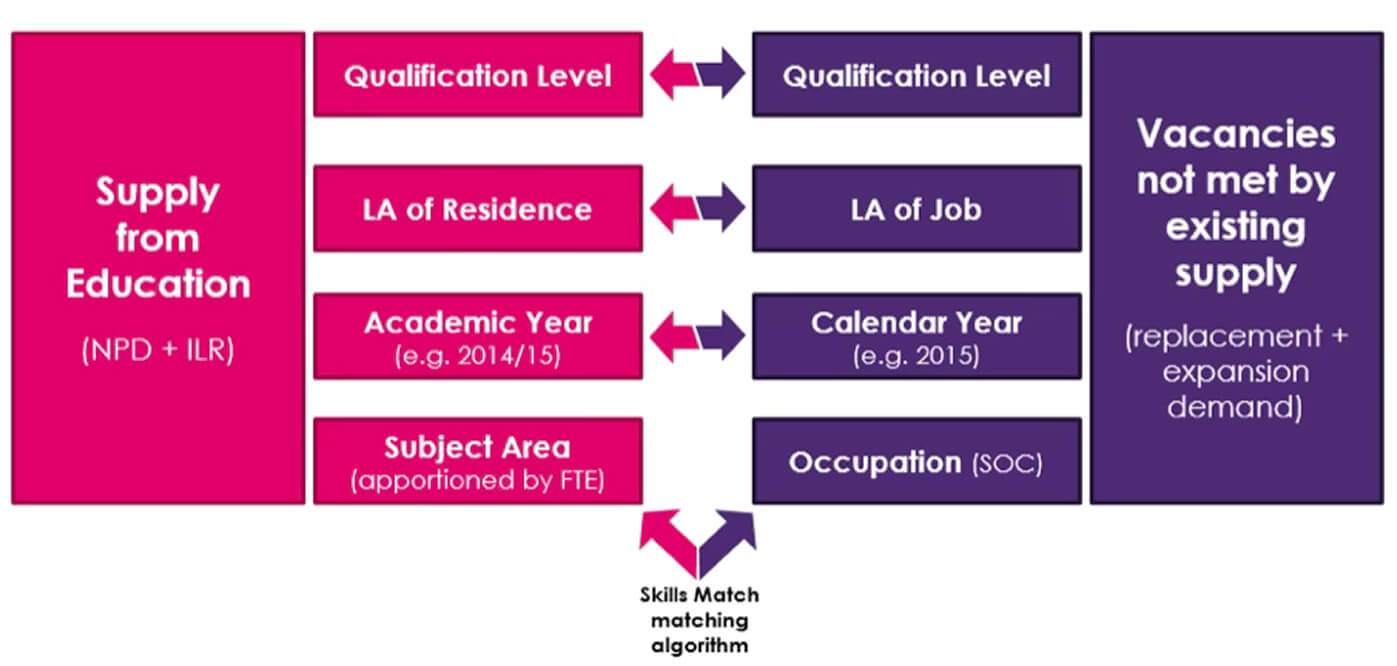
4. Using the source data above, applying the matching algorithm, and using population and job forecasts to reveal, by sector, where the future skills coming from schools and colleges are not aligned to the needs of industry. The analysis was broken down by qualification level, from entry level to level 3, and local authority.
5. Visualising the resulting analysis on a series of online dashboards, and creating an intuitive interface so that anyone from each of the user personas identified would be directed straight to the analysis that fits their needs.
The impact of our work

 Skills Match won an Open Data Breakthrough Fund award for its ground-breaking approach and was also featured on a double page spread in the London Evening Standard. It is ten years old now, and has been used tens of thousands of times by a diverse range of users, and is still considered innovative in its approach. As well as the website itself, the underlying datasets have been used in multiple applications, and we were featured on the LMI for All website as an outstanding example of using labour market data in far-reaching ways.
We carried out an evaluation after 6 months of launch, with very positive feedback. This revealed that careers advisors and policy makers were the most common users, and that local authorities had already used it to identify potential over- and under-supply of skills provision in particular sectors, and in turn to plan future developments with local skills providers. We were also approached by other regions about doing something similar elsewhere.
At a launch event at PWC, one local authority manager neatly summarised Skills Match as “another impressive product by Mime”!


