

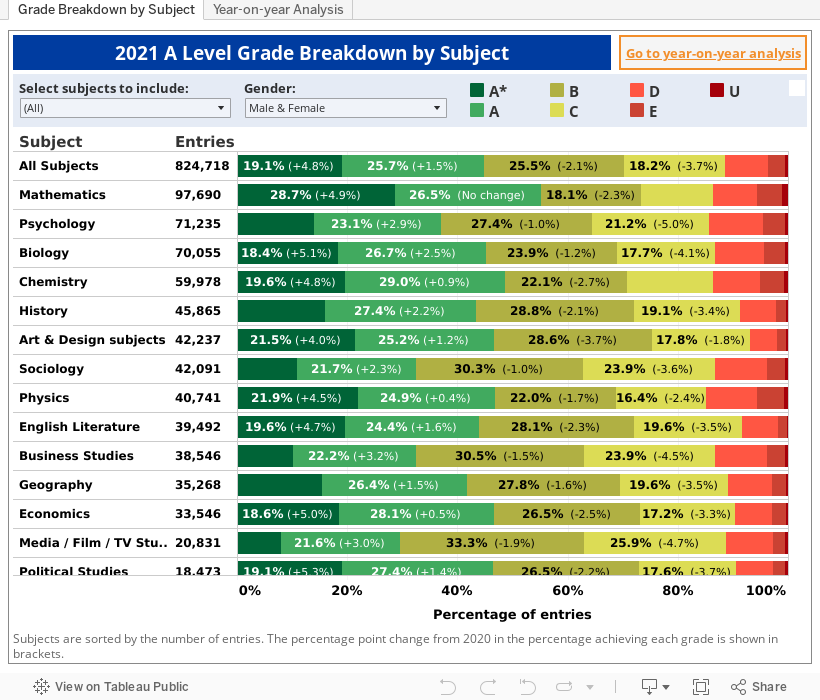
There has been a lot of attention given to what impact this year’s grading system will have on A level grades. This blog explores the initial JCQ 2021 A level data for across the UK. The tool below allows you to compare A level grade breakdowns between subjects and split the data out by gender. Clicking ‘Go to year-on-year analysis’ lets you explore how a subject’s results in 2021 compare to 2020 results.
Across the UK, there was an increase from 2020 in the proportion of entries achieving an A* or an A and a fall in those achieving Bs, Cs and Ds. The increases in As and A*s are particularly noteworthy given the large increase in top grades we saw in 2020.
Explore this year’s A level grades in our interactive tool
A few key findings
- The largest change was in the proportion of entries achieving an A*. Across all subjects, there has been a 4.8% point rise in A*s, up to 19.1% of all A level entries. This increase is slightly larger for female pupils’ entries, up 5.3% points to 19.7%
- Languages A levels saw large improvements, with 34.6% of all German A levels achieving an A*, up 11.2% points on 2020. Similarly, the percentage of Spanish A levels achieving an A* was from 21.7% to 31.0%
- Of subjects with more than 10,000 entries, English language, media/film/TV studies and business studies saw the lowest rates of entries achieving an A*
- With a 7.6% point increase in A*-As, there were larger increases in the percentage of entries achieving top grades in Biology than for Physics or Chemistry
- There was a much larger rise in A*s for further maths than maths. In fact, almost half of all further maths A levels achieved an A*, up from 41.8% in 2020.
Check out our 2021 GCSE grades interactive tool here


