

2022 represents a return to exams after two years of disruption due to the COVID-19 pandemic and for A level candidates, these will be the first external exams they’ve sat since primary school, having received assessed grades for their GCSEs. Ofqual had previously advised that 2022 would be treated as a transition year, with grades broadly between those seen in 2019 and 2021.
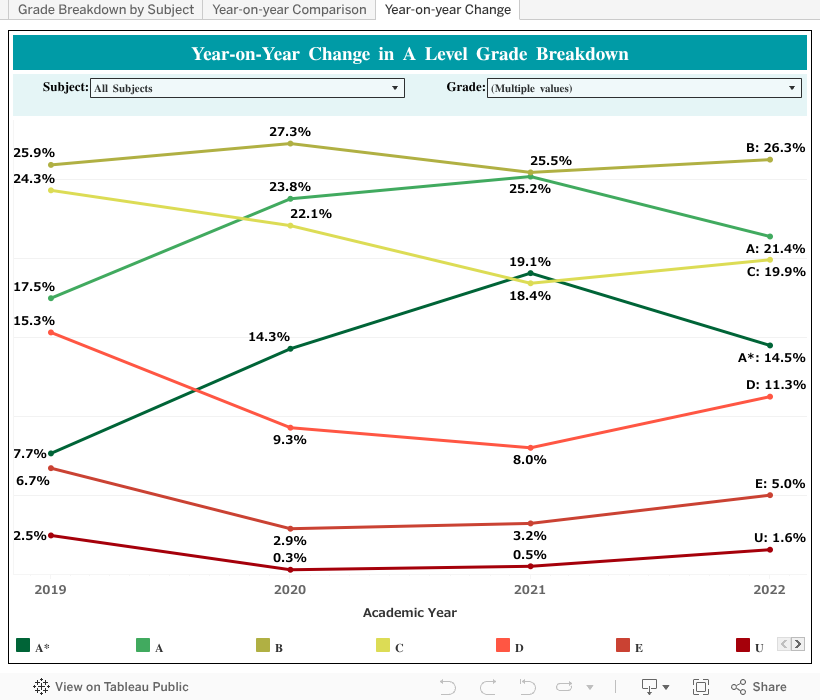
This blog explores the initial JCQ 2022 A level data for England and you can use the tools below to explore trends over time and subject grade breakdowns. As expected, there have been falls in the proportions of entries achieving the top grades, with grade distributions between 2021 and 2019 levels.
Grade breakdown over time
As expected, overall outcomes are in line with Ofqual’s intentions, with outcomes higher than 2019 – the last year of exams – but lower than 2022.
Explore specific changes over time in our interactive tool
NB. You can see different data views using the tabs and look at grade groupings using the “Grade” dropdown on the line chart
A few key findings
- As expected, the proportion of entries across all subjects achieving A* and A grades fell from 2021 to 2022, while the proportions achieving all other grades rose. However, at 14.5%, the proportion of entries across all subjects achieving an A* grade is still around double the 2019 levels. At the other end of the scale, the proportions of entries achieving a C and D grade are both still 4.4% points and 4% points below the 2019 value respectively
- Excluding other modern languages, further maths was the only subject to see an increase in the proportion of entries achieving an A grade from 26.2% in 2021 to 27.5% in 2022. It is also the subject whose proportion of entries achieving A* grades is the furthest from 2019 levels
- Law is the subject where the proportion of entries achieving an A* is now closest to 2019 levels. Despite this, there is still a 3.9% point difference between 2019 and 2022
A level grade breakdown by subject
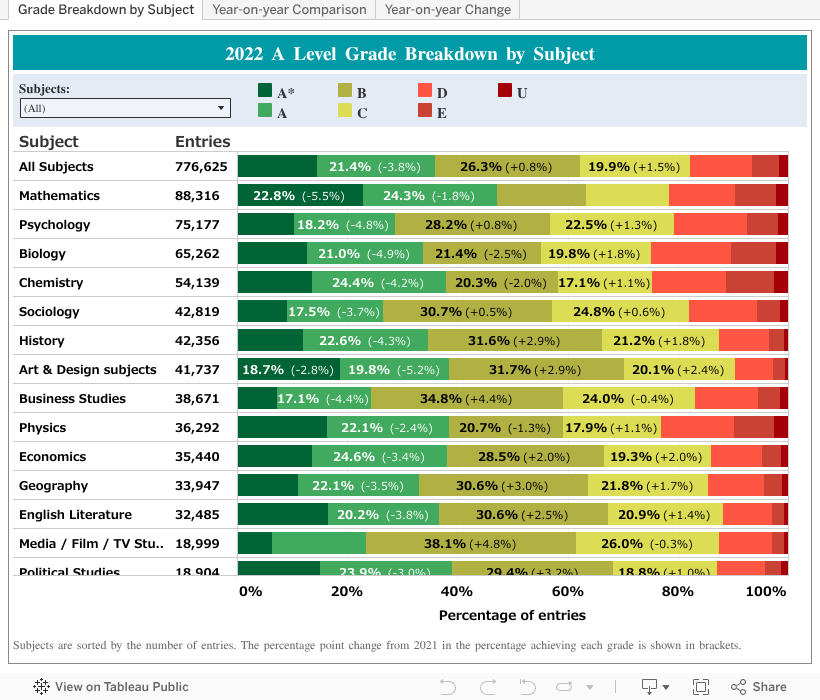
There have been changes in the subjects sat by A level students over time. Trends analysed by the JCQ show a steady increase in the number and percentages of entries in psychology. In 2022, there were 75,177 entries in Psychology, equivalent to almost a tenth of all A levels sat and the second most popular choice. Mathematics, however, remains the most popular choice with 88,316 entries.
Explore this year’s A level grades by subject in our interactive tool
A few key findings
- Entries across all subjects saw a fall in the proportion of entries achieving A* or A grades from 2021 with an associated rise in the proportion of D grades
- Despite a fall from 2021, further maths had the highest proportion of entries receiving an A* grade at around two out of every five (39.7%) entries. This is still well above the 24% of entries in 2019 that achieved an A*
- Modern language subjects also had a strong performance in 2022, with German, Spanish, French and other modern languages all seeing at least 20% of entries achieving an A*
- On the other hand, English language had the lowest proportion of entries achieving an A* at just 6.2%. Over a third (35.3%) of entries achieved a B grade and 28% achieved a C grade


