

2022 represents a return to exams after two years of disruption due to the COVID-19 pandemic and Ofqual had previously advised that 2022 would be treated as a transition year, with grades broadly between those seen in 2019 and 2021.
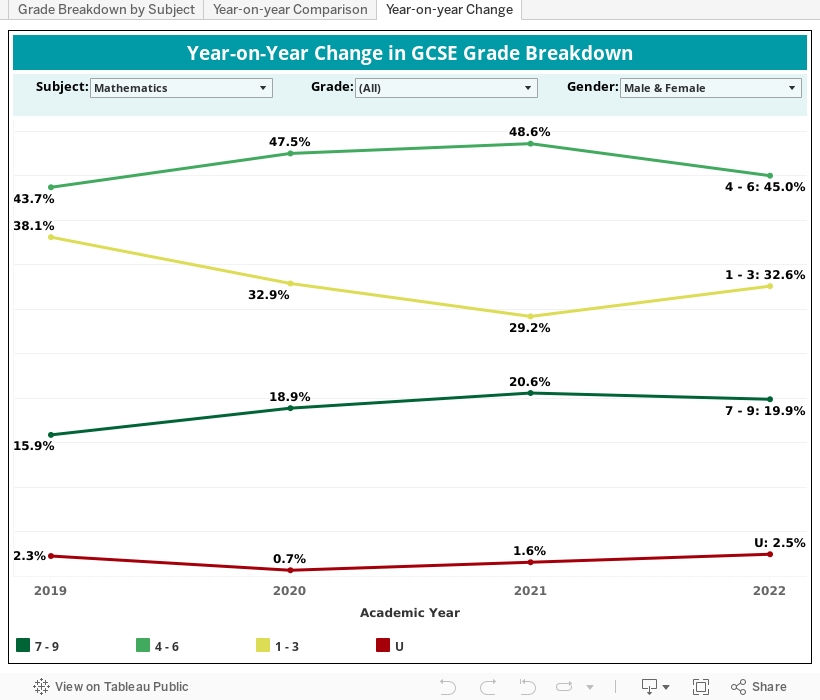
This blog explores the initial JCQ 2022 GCSE data for England and you can use the tools below to explore trends over time and subject grade breakdowns. As expected, there have been falls in the proportions of entries achieving the top grades, with grade distributions between 2021 and 2019 levels.
Grade breakdown over time
As expected, overall outcomes are in line with Ofqual’s intentions, with outcomes higher than 2019 – the last year of exams – but lower than 2022.
Explore specific changes over time in our interactive tool
NB. You can see different data views using the tabs
A few key findings
- As expected, the proportion of entries across all subjects achieving at least a grade 7 fell from 2021 to 2022, but remained above 2019 levels. At the other end of the scale, the proportion of entries across all subjects achieving a grade 3 or below was above both 2020 and 2021 levels but below 2019.
- Physical education had outcomes furthest from 2019 levels. At 9.9% in 2022, the proportion achieving a 9 was well over double the 3.8% who achieved a 9 in 2019. Additionally, around a third (34.1%) achieved at least a seven in 2022, compared to 21.1% in 2019.
- In contrast, mathematics saw relatively low levels of variation in the proportion achieving the top grades. For example, 19.9% of entries achieved at least a 7 in 2022, compared to 20.6% in 2021 and 15.9% in 2019.
GCSE grade breakdown by subject
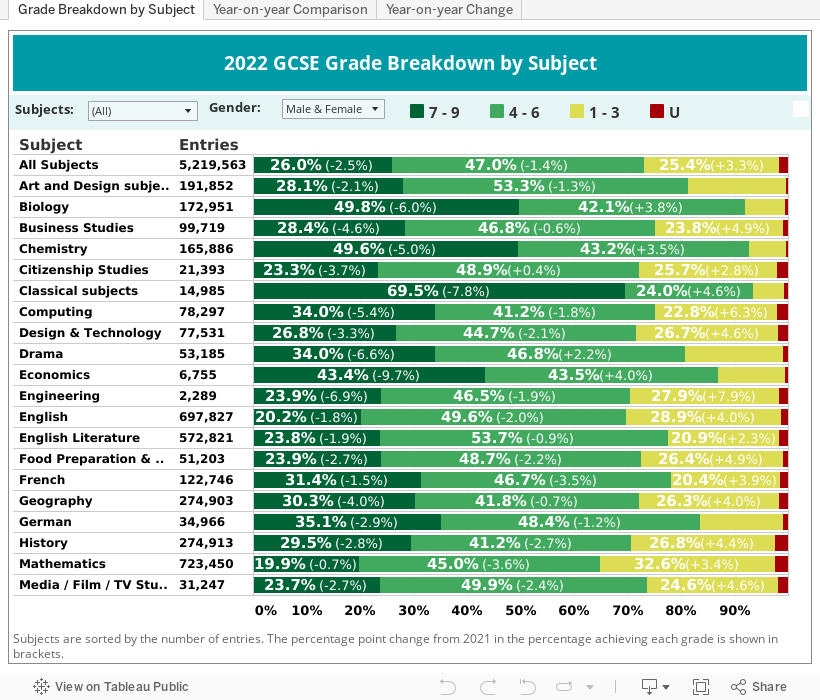
Comparisons produced by the JCQ show that grades vary across England regions. At 32.6% of entries, London had the highest proportion achieving at least a grade 7 while the North East and Yorkshire and the Humber were both lowest at 22.4%. Our analysis also shows variation by subject and gender.
Explore this year’s GCSE grades by subject and gender in our interactive tool
A few key findings
- Continuing the trend from recent years, female pupils broadly outperformed male pupils. Looking at entries across all subjects, 29.6% of entries from female pupils achieved at least a grade 7 compared to 22.4% for male pupils. However, this gender gap is narrower than the equivalent gap in 2021
- In 2022, Engineering had the largest gender gap in the proportion of entries achieving the top grades. 19.5% of entries from male pupils achieved at least a grade 7, less than half the 39.8% of entries from female pupils
- Mathematics, on the other hand, had the narrowest gender gap with 20.4% of entries from male pupils and 19.3% of entries from female pupils achieving at least a grade 7. However, this reversed the trend from 2021, when female pupils outperformed male pupils for the first time in recent years.
- Classical subjects had a strong performance, with around 7 in every 10 entries achieving at least a grade 7, the highest proportion of any subject.
- Single award science subjects also had relatively large proportions of the top grades, with Physics, Biology and Chemistry all awarding around half of entries at least a grade 7. In contrast, double award science had the lowest proportion of entries achieving at least a grade 7, at just 10%.


