

This blog explores the initial JCQ 2025 GCSE data for 16-year-olds in England and you can use the tools below to dig deeper into trends over time and subject grade breakdowns.
Grade breakdown over time
Explore subject level changes over time in our interactive tool
Overall, GCSE entries have decreased from 5.2 million in 2024 to 5.1 million in 2025. The proportion of pupils achieving top grades has increased slightly, with 23% of entries achieving grades 7-9 in 2025, an increase of 0.32% points from 2024. However, the proportion of pupils achieving pass grades (4+) remains relatively unchanged, at 70.5% in 2025 compared with 70.4% in 2024.

A few key findings
- Biology, Physics and Chemistry have all seen notable increases to the proportion of entries achieving grades 7-9. Since 2024, entries in Biology, Physics, and Chemistry have fallen, while entries in double science have increased, which likely resulted in a stronger remaining cohort sitting triple sciences.
- French, German and Computer Science also saw continued large increases to the proportion of pupils achieving top grades, following Ofqual’s instruction to exam boards in 2024 to award grades more generously for these subjects.
- English Language grades have become slightly more polarised in 2025, with a relatively large decrease of 1.1% points to the proportion of entries achieving grades 4-6, but increases to the proportions achieving both grades 7-9 and 1-3.
Grade breakdown by subject
Explore this year’s GCSE grades by subject in our interactive tool
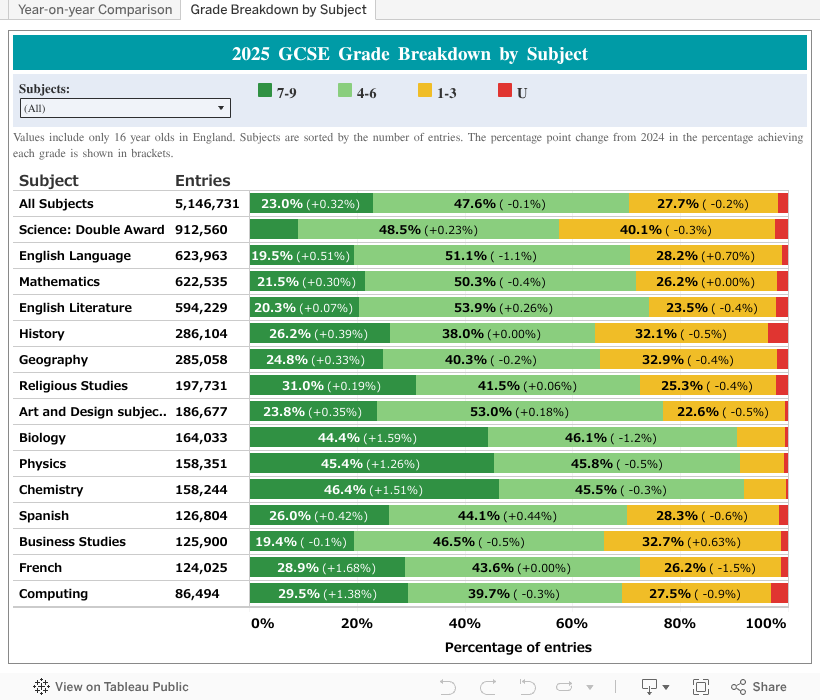
A few key findings
- Outcomes for Biology, Physics and Chemistry pupils are very strong, with around 45% of entries achieving grades 7-9 and less than 10% achieving below grade 4 for each subject. In contrast, only 9.1% of double science pupils achieved grades 7-9, and just over two in five (42.5) achieved below grade 4.
- Across all subjects, History saw the biggest decrease in entries from 2024 to 2025, though this remains the most popular subject outside of Maths, English and Science. Conversely, entries in Geography have notably increased.
- Similarly, Music and Statistics also saw a relatively large growth in entries compared to the previous year, with a percentage increase of 6.3% for Music, and 5.2% for Statistics.


