Mime’s work on early years data and progress tracking
We have been working on early years strategy, analysis and tracking since 2009, with a particular focus on supporting practitioners, schools and local authorities to understand children’s development and make better use of the information they collect. This sits within our wider work to help local areas understand children’s needs and outcomes across the education system, including our Funding Futures tool that supports the government’s Best Start in Life initiative and our Super School Profiles which include an early years focus. The common thread is making information clearer and more useful for identifying need and targeting support, and understanding whether that support is making a difference.
The EYFS (Early Years Foundation Stage) Tracker
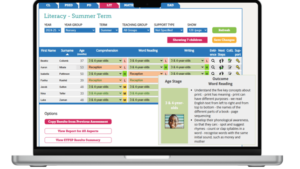
 The cornerstone of our early years analysis work is our EYFS Tracker, originally developed in partnership with Wandsworth Council nearly 20 years ago – although it’s had a few facelifts since then! It is a web-based tool for recording and visually analysing children’s progress from birth to five. The tracker already supports both DfE and Birth to 5 early years frameworks and has recently been updated to include the revised Birth to 5 Matters guidance under licence from the Early Education Coalition.
This update has prompted us to take a wider look at the thinking behind the Birth to 5 framework and what good early years data and assessment should enable.
About Birth to 5 Matters
The Birth to 5 Matters guidance takes a holistic, child-centred view of development rather than treating progress as a simple linear journey through a series of milestones. In this approach, development is considered in the round, including physical, social and emotional wellbeing, learning, family, community and culture. While the Department for Education’s (DfE) EYFS framework sets out the statutory requirements, Birth to 5 Matters gives practical guidance to help practitioners meet their responsibilities across the EYFS and support children’s progress towards the Early Learning Goals. The two are closely linked, but there are some differences in approach, language and emphasis that practitioners should be aware of when using the guidance in practice.
The Birth to 5 Matters guidance covers areas including A Unique Child, Positive Relationships, Enabling Environments, Learning and Development, observation, assessment and planning, as well as the different areas of learning.
The revised edition keeps a lot of the approach practitioners will already recognise, but there are changes throughout. These include new material on digital pedagogy, sustainability and environmental stewardship, and additional guidance covering different stages of early childhood, from birth through to Reception and beyond.
Why Birth to 5 Matters uses a different approach
At the heart of the Birth to 5 approach is the philosophy that early development is difficult to reduce to data points. This is reflected in the way progress is recorded: Birth to 5 does not break development into sub-levels or encourage practitioners to tick off individual statements as they are achieved. This helps avoid giving the impression that children develop in a fixed sequence and keeps the focus on the overall picture of a child’s development. As children develop at different rates across different areas, assessment needs to sit alongside practitioners’ observations and professional judgement.
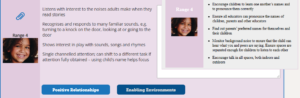
Birth to 5 goes beyond assessing what a child can do, but places emphasis on Positive Relationships and Enabling Environments. This encourages practitioners to consider how relationships with adults, experiences, routines and the physical and emotional environment can support a child’s learning and development, and how they might change their provision to what they observe.
The value of observing and tracking development is ultimately in helping practitioners decide what to do next, rather than simply documenting progress or generating more data. Used well, assessment in this way can help identify where additional support or an intervention may be beneficial and provide a way of understanding whether that support is having the intended effect. The EYFS Tracker can therefore help organise and reveal patterns in this information, to decide what interventions might be useful.
For us, this is one of the real strengths of the Birth to 5 approach. Tracking should help practitioners to build a fuller picture of a child and feel more confident about what to do next, rather than simply creating more data.
How this links to early years settings
Tracking progress becomes particularly important as local authorities seek to intervene earlier and target support towards children who need it most. This is particularly relevant in the context of the government’s Best Start in Life agenda, with local authorities working towards improved Good Level of Development (“GLD”) outcomes and higher targets for 2028. Our recent discussions with local authorities have highlighted the particular challenge of supporting children in private, voluntary and independent early years settings where interventions may be put in place, but there is not always a consistent mechanism for tracking subsequent development and understanding impact. A shared approach to progress tracking helps to bridge that gap, not simply recording that an intervention took place but helping to understand what happened afterwards.
Early years data of this kind can be useful at different levels. At the child and setting level, it can inform conversations about development, next steps and reveal patterns in needs and outcomes. At the local authority level, it can help identify inequalities between groups or areas, understand where children are missing particular Early Learning Goals, target resources and understand whether programmes and interventions are associated with improvements.
SEND reforms context
This is all especially relevant in the context of the government’s current SEND reforms agenda. The reforms place a much stronger emphasis on identifying needs early and providing evidence-based support before difficulties escalate. In the early years specifically, the proposals envisage settings playing a greater role in identifying and meeting needs as early as possible, alongside monitoring children’s progress to understand whether interventions are effective. This makes good quality developmental data increasingly important. Using a tracking tool can be part of the evidence that practitioners and local authorities use to spot emerging needs and understand children’s progress before and after additional support to build a clear picture of what appears to be working.
Mime’s approach
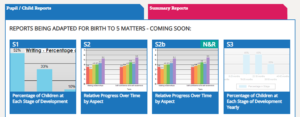
Our approach to monitoring and intervention is reflected in our design of the EYFS Tracker in making complex information easier to understand and act on, while keeping professional judgement and the child at the centre. The Tracker has been designed with flexibility in mind, supporting the way that settings want to work, rather than enforcing a rigid approach to data collection and analysis. Around one quarter of settings using the EYFS Tracker currently use the Birth to 5 Matters framework, showing that it has become an established alternative to the DfE approach for many settings.
We also know that not everything affecting a child’s development sits within the control of an individual setting. Our Funding Futures research highlighted the importance of the wider local system, including access to high-quality early education and integrated support for families. This means local authority leadership has an important role to play in bringing services together, identifying where additional support is needed and tackling more systemic issues, for example, through better coordination of local services.
The wider opportunity here is to then connect information about children’s development, needs and support so that practitioners and local authorities can answer the questions that matter: Where is support needed? What are we doing about it? And is it making a difference?
Find out more
You can explore the revised Birth to 5 Matters guidance on the Birth to 5 Matters website: Explore the Birth to 5 Matters Guidance
If your setting or organisation is also reviewing its approach to EYFS tracking this academic year, you can find out more about Mime’s EYFS Tracker, including its visual progress tracking, graphical analysis and learning journey features. Mime also offers a free six-week trial for settings that would like to explore it in practice.
Find out more about Mime’s EYFS Tracker: Explore the EYFS Tracker