

This blog explores the risks of being excluded when ethnicity, SEND status and FSM eligibility are combined.
Exclusions from schools – both fixed term suspensions and permanent exclusions – are meant to represent a school’s last resort. This is appropriate, as outcomes for pupils who have been excluded are often poor when compared to their peers. Research from the Institute of Public Policy Research reported that, in 2017, just 1% of excluded pupils achieved five good GCSEs including English and maths and these pupils were very likely to experience long-term unemployment.
What we know already
It has long been established that certain groups of pupils are more likely to be excluded than others. The Timpson review on exclusions was conducted in 2019 and found that boys, disadvantaged pupils, pupils with SEND and those from certain ethnic groups had higher rates of exclusions, both permanently and for a fixed period.
While overall levels of exclusion fell during the pandemic, most likely due to school closures, we know that these differences have persisted. In the 2020/21 academic year (the most recent year for which exclusions data has been published), there are clear differences between pupils based on their characteristics. For instance, pupils eligible for free school meals (FSM) were around three times as likely to have been suspended compared to their peers and four times as likely to be permanently excluded.


What about pupils with multiple “risk factors”?
What isn’t currently clear from the publicly available data is how characteristics interact with each other to impact the risk of exclusions. For instance, the existing data does not allow us to compare Black FSM eligible pupils with SEND to Black FSM eligible pupils without SEND.
In order to conduct this analysis, we submitted a Freedom of Information (FOI) request to the Department of Education (DfE). They provided us with exclusion data that contained this level of detail.
We were then able to explore how exclusion rates vary between pupils based on their ethnicity, SEND status and eligibility for FSM.
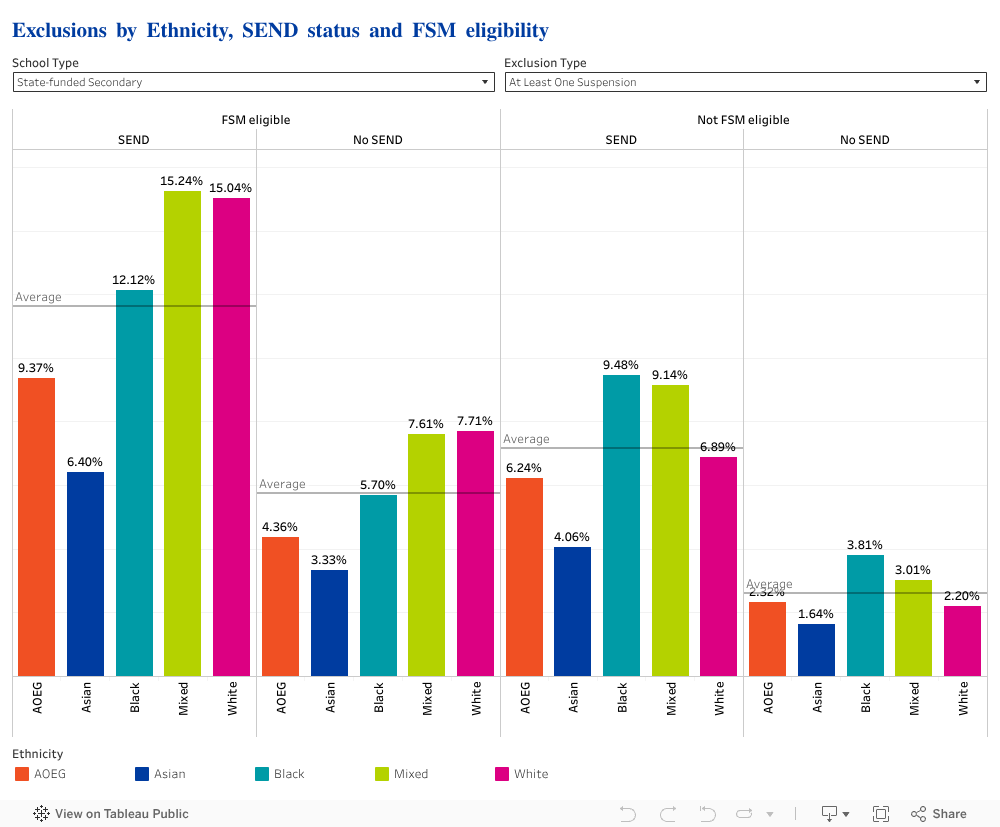
Explore different exclusion rates in our interactive tool
Suspensions – Key Takeaways
- At both state-funded primary and secondary schools, Mixed pupils who had SEND and were FSM eligible were the most likely to have been suspended at least once
- At state-funded secondary schools, ethnic differences changed depending on FSM status:
- For pupils who were not FSM eligible, Black pupils were the most likely to have been suspended at least once, regardless of SEND status
- On the other hand, for pupils who were FSM eligible, Mixed and White pupils were the most likely to have been suspended at least once, again regardless of SEND status
- At both state-funded primary and secondary schools and for all ethnic groups, SEND status was a bigger risk factor for suspensions than FSM eligibility. In other words, pupils who were not FSM eligible but had SEND were more likely to be suspended than those who had no SEND but were FSM eligible.
Permanent Exclusions – Key Takeaways
- The pupils most likely to be permanently excluded varied between state-funded primary and secondary schools
- At state-funded primary schools, Mixed pupils with SEND and who were eligible for FSM were the most likely to be permanently excluded
- At state-funded secondary schools, it was instead White pupils with SEND and who were eligible for FSM who were the most likely to be permanently excluded
- SEND status was a bigger risk factor for permanent exclusions than FSM eligibility for pupils from every ethnic group except White pupils
- Conversely to all other ethnic groups, White pupils who were eligible for FSM without SEND were more likely to be permanently excluded compared to White pupils with SEND who were not eligible for FSM
- Black pupils who were not FSM eligible had above average rates of permanent exclusions, regardless of SEND status, while Black pupils who were FSM eligible had below average rates of permanent exclusions, again regardless of SEND status
Conclusions and Next Steps
Much of this new data confirmed what we had predicted, that multiple risk factors would compound the relative risks of exclusion for pupils. However, what this has revealed is the interaction between these risk factors. For instance, combining FSM eligibility and ethnicity suggests that, for pupils from different ethnic groups, FSM eligibility has a variable effect on the likelihood of being excluded.
There are vast opportunities for further research and investigation in this area, including:
- Analysing data that contains more detail on pupil’s ethnicities as aggregating pupils into larger ethnic groups may mask differences between, for instance, Black African and Black Caribbean pupils
- Adding primary need as a further characteristic for analysis to understand whether the risk of being excluded varies within those who have SEND


