

Background
Children from disadvantaged backgrounds too often start school already behind their peers, and these gaps frequently widen as they move through education and into adulthood. While this pattern is familiar nationally, some local areas are successfully bucking the trend and putting disadvantaged children on a much more positive trajectory.
Launching the Funding Futures resources

Over the past year, with funding from Collective Futures, the Henry Smith Foundation and the Ethos Foundation, we have worked with Isos Partnership and the Education Policy Institute on a major early years project: Funding Futures. This new set of research reports and online tools is designed for charitable funders, local authorities and policy makers who want to target resources in early childhood more effectively.
Drawing on qualitative and quantitative evidence – including fieldwork in seven local authorities that are outperforming expectations – the Funding Futures resources show how local areas can use funding, partnerships and data to improve outcomes for disadvantaged children.
In November, we hosted a webinar for local authorities with Isos, showcasing the research and offering a hands-on opportunity to explore the tools. Attendees shared extremely positive feedback on both the content and the usability of the dashboard. We also had the pleasure of presenting the work alongside Stella Creasy MP at a launch event at Walthamstow Family Hub, with stakeholders from across the early years sector.
What successful local areas are doing differently
Local authorities that have made the greatest progress in improving outcomes for disadvantaged children shared a number of common features in their early years systems:
-
Integrating services around children and families, for example through family hubs and children’s centres.
-
Ensuring access to high-quality early years education; the proportion of 3- and 4-year-olds in Ofsted outstanding provision was statistically associated with smaller disadvantage gaps.
-
Engaging and supporting parents through evidence-based programmes such as the Solihull Approach, PEEP Learning Together and Home Start.
-
Prioritising speech, language and communication, including screening, staff training and strong partnerships with the NHS.
-
Identifying additional needs earlier, using targeted support initiatives, SENIF funding and multiple contact points across services like health and children’s centres.
These approaches are underpinned by enabling conditions, including visible senior leadership commitment, strong early years partnerships – particularly with the voluntary and community sector – trusting relationships, and a data-informed culture.
Inside the Funding Futures data dashboard
To support local strategic planning, the Funding Futures data dashboard brings together public data used in our regression analysis and shows how local authority characteristics relate to the size of the disadvantage gap.
The analysis highlights several factors that appear to be associated with smaller gaps, including:
-
A higher proportion of 3- and 4-year-olds in state-funded provision.
-
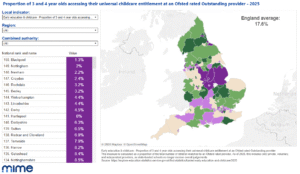
A higher proportion of 3- and 4-year-olds in outstanding provision.
-
Higher spend per capita on Sure Start children’s centres.
The dashboard is structured in three main parts to help users explore these relationships:
-
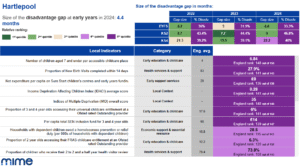
An LA table to review a single local authority’s performance across a range of indicators.
-
An England map to compare one indicator across all local authorities.
-
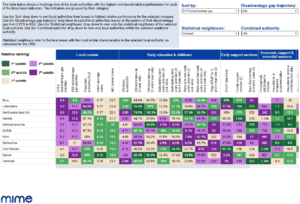
A detailed heatmap providing a full table of local authorities and indicators, with the option to filter for statistical neighbours.
Together, these views allow users to understand their local context, compare themselves with similar areas and identify where there may be opportunities to learn from others.
 How to explore the reports and tools
You can find out more and start using the Funding Futures resources here:
-
Funding Futures website: https://www.funding-futures.org/
-
Data dashboards: https://mime.org.uk/client-resource/funding-futures-data-tool/
-
Summary research report: https://www.funding-futures.org/s/Funding_Futures_Summary_Report.pdf
-
Statistical analysis of local authority factors: https://www.funding-futures.org/s/Funding_Futures_Stastical_Analysis.pdf
If you would like to discuss how the findings relate to your local area, or explore tailored support in using the tools, please get in touch.
Webinar feedback
Feedback from the launch webinar and workshops has highlighted both the usefulness of the insights and the practicality of the tools:
-
“An amazingly helpful session… feels like we have been supported to make a big step forward, thank you.”
-
“This has been an excellent and useful workshop… the tool will be very useful, very grateful.”
-
“Such a good tool, I’m so glad I came to this meeting, so helpful.”
-
“This workshop was very useful! Looking forward to sharing the recording and slides with colleagues.”
-
“This is so incredibly helpful… the learning from other LAs has been very informative.”


