The number of young people who are NEET – not in education, employment or training – reached 981,000 in April to June 2026, an increase of 30,000 on the year. This is equivalent to 13% of 16-24-year-olds. Disabled young people are three times more likely to be NEET than their non-disabled peers.
Alan Milburn’s final report From a Welfare State to a Working State: A new settlement for the next generation, published today (17 November), sets out suggested solutions to the rising number of young people who are NEET, with a particular focus on those with disabilities. The government is due to set out its response by the end of the year with a White Paper and legislation expected to follow in 2027.
Supported internships provide tailored support to help young disabled people into work and have been identified in the Milburn report as one of a range of solutions that could help tackle the NEET crisis. As the UK’s leading SEND data specialist, Mime’s research has developed valuable insights into the outcomes achieved by young people with SEND and the barriers they and employers face.
We’ve been supporting West Lea School in Enfield with its supported internship programme. Using the Department for Education’s recent national evaluation, we’ve helped West Lea see how its programme compares with others across England and what’s working elsewhere. We’re also supporting the school in its conversations with the DfE and other public sector organisations working for change.
What are supported internships?
Supported internships are work-based study programmes designed primarily for young people aged 16–24 who have an Education, Health and Care Plan (EHCP).
They provide valuable, real-world workplace experience, alongside tailored support and the development of practical employment skills. The aim is to help young people with special educational needs and disabilities (SEND) build greater independence and move into paid employment.
Between 2022 and 2025, the Department for Education invested £18 million in a supported internship programme. It primarily supported young people with an EHCP but later expanded to include a pilot of internships for non-EHCP students with a social, emotional or mental health need or learning difficulty or disability.
What does the data tell us?
Our evaluation explored both the outcomes achieved by young people and the barriers that can affect their progress.
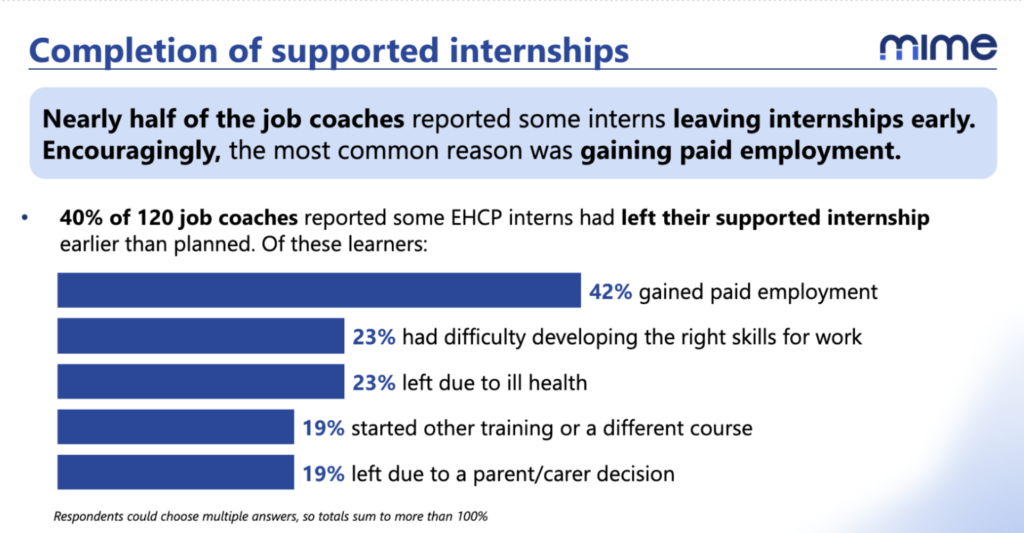
One finding concerned early departures from supported internships. 40% of 120 job coaches surveyed reported that some interns with EHCPs had left their supported internship earlier than planned. Early departure sounds like a failure but looking at the data, we learned that the reasons for leaving included:
- 42% gained paid employment.
- 19% moved into other training or a different course.
- 23% experienced difficulties developing the skills needed.
- 23% left due to ill health.
- 19% left following a parent or carer’s decision.
These figures demonstrate that young people’s journeys are unique. Some encounter barriers that make completing an internship difficult, while others move into employment or alternative learning opportunities before their planned programme ends. Understanding these different experiences is essential to improve future programme design.
Success is about more than employment figures
Alongside the reported employment outcomes, nearly three-quarters of young people surveyed said they felt better prepared for the world of work and adulthood after taking part in a supported internship.
Other findings include:
- 88% enjoyed their work placements
- 80% improved their skills and knowledge about working, workplace rules and how to work in a team.
Increased confidence and independence were also frequently reported.
These outcomes matter. Preparing for employment is not simply about learning the tasks required for a job. For young people with SEND, these experiences can be important stepping stones towards a more independent future in multiple ways.
West Lea school in Enfield– the only state-funded special school to offer supported internships
West Lea is the only state-funded special school identified through the research that offers a supported internship programme themselves. Our evaluation of supported internships across England involved comparing best practice to West Lea’s programme.
Our analysis of how their offer compared to others funded by the DfE programme showed the importance of tailored, work-based learning. By really understanding their students, tailoring the support they offer and teaching a personalised curriculum, most young people at West Lea taking part in the supported internship completed their course, and a significant number went on to paid employment.
Support for employers needed too
Currently most supported internships are in the health and social care sector closely followed by catering and hospitality. To grow the number of supported internships requires employers to better understand how they can accommodate disabled young people in the workplace.
Employers cite barriers and concerns about supported internships including a lack of understanding of people with SEND, concerns about the time and capacity required to support interns and a belief they have no suitable jobs.
Interestingly, the Milburn report suggests offering financial incentives to employers to encourage them to take on young people who have been NEET for at least six months, with an additional incentive if the young people is disabled. However, this financial incentive is not the full solution.
Successful programmes of supported internships are modelled on providing jobs and tasks that are needed by a company and can be fulfilled by a young disabled person with necessary adjustments and support. This is more successful at creating meaningful work experience and the prospect of a long-term job than when a young disabled person is given a temporary job that has been created ad hoc for them.
Where do we go from here?
From the Milburn Report it tells us 45% of NEETs are disabled or in ill health. If we are serious about tackling the NEET crisis, we need to look beyond headline figures. Supported internships are not a universal solution. However, they offer a valuable route into the workplace for young people who might otherwise face significant barriers to employment.
Mime’s Risk of NEET toolkit allows local areas, schools and colleges to explore the characteristics of young people most at risk of being NEET. We use a range of data sources including prior attainment, ethnicity, SEND, deprivation, attendance, exclusions and more. We also apply the same techniques for younger age groups to facilitate earlier intervention.
Mime’s data analysis and insights help local authorities, schools and colleges identify young people most in need of support and plan earlier interventions. By understanding what works and where barriers remain, we can help improve Supported Internships and create more opportunities for young people with SEND to move into employment, further education or training.
At Mime, we’re committed to turning data into insights that improve lives.